
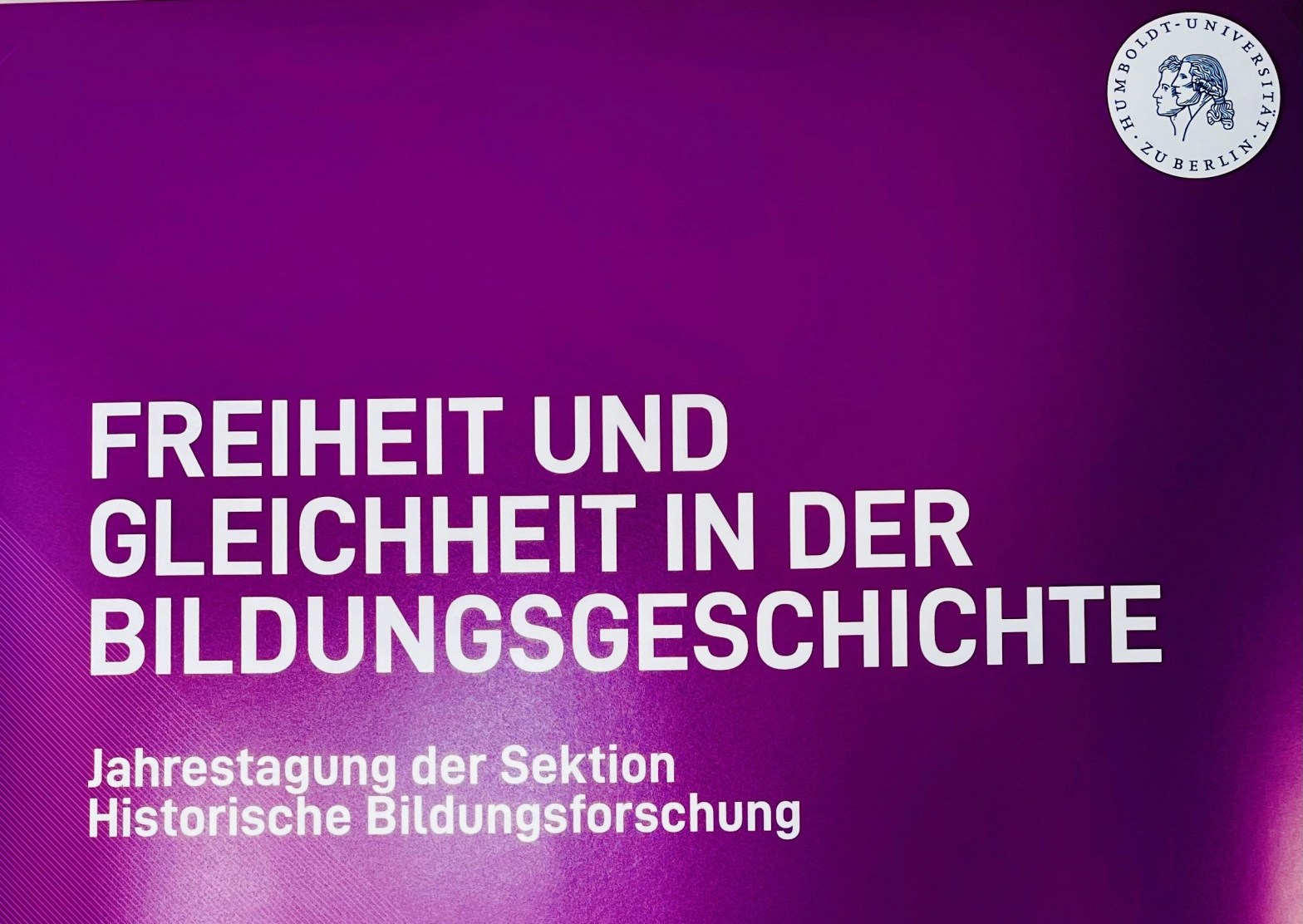
Humboldt-Universität zu Berlin | 11. bis 13. September 2023
English version below
Vom 11. bis 13. September fand an der Humboldt Universität Berlin die Jahrestagung der Sektion Historische Bildungsforschung der Deutschen Gesellschaft für Erziehungswissenschaft statt. Organisiert von Marcelo Caruso, Till Kössler und Sabine Reh diskutierten wir Fragen von Freiheit und Gleichheit in der Bildungsgeschichte, wobei neben gegenstandsbezogenen und method(olog)ischen insbesondere auch wissensgeschichtliche und (standpunkt)epistemologische Fragen in den Fokus rückten.
Wie können wir Un/Gleichheit (historisch) beforschen? Und welche Rolle spielt Bildung darin, wenn wir davon ausgehen, dass es sich bei ihr um ein »Scharnier [handelt], das in beide Richtungen funktioniert« (Thomas Mergel | Podiumsdiskussion)?
Epistemologische Fragen wurden ebenfalls im Zuge der Eröffnung des Digital History of Education Lab der Bibliothek für bildungsgeschichtliche Forschung adressiert, die vor allem im Anschluss an die Keynote von Torsten Hiltmann kritisch diskutiert wurden. Denn: (In)Wie(fern) verändert sich (bildungs)historisches Forschen angesichts von Digitalisierung und unter Bedingungen von Digitalität? Transformieren sich tatsächlich die grundlegenden Logiken?
Im Rahmen der Mitgliederversammlung wurde zudem ein neuer Vorstand gewählt: Esther Berner, Michèle Hofmann und Michaela Vogt. Und ein großer Dank wurde und wird Marcelo Caruso für seine Arbeit als bisheriger Vorstandsvorsitzender zuteil.
Im Vorfeld der Sektionstagung fand zudem das 15. Forum junger Bildungshistoriker_innen statt, bei dem 15 Promovierende die Gelegenheit hatten, ihre Projekte – unabhängig des Tagungsthemas – vorzustellen und zu diskutieren. Organisiert wurde das Forum von Andreas Oberdorf und Stefanie Vochatzer und ich selbst hatte das Vergnügen, als Chair des Panels zu Erziehungs- und Bildungsmedien zu fungieren.
Auch die Sprecher_innen der Emerging Researcher wurden neu gewählt, da die Amtsperiode(n) von Andreas Oberdorf endete. Die Wahl fiel auf Anna Strunk und Stefanie Vochatzer, die unmittelbar mit Überlegungen zur Ausgestaltung des 16. Forums junger Bildungshistoriker_innen begannen.
[English Version] From 11 to 13 September the Conference for the History of Education of the German Society for Educational Research was held at the Humboldt University Berlin. Organised by Marcelo Caruso, Till Kössler and Sabine Reh, we discussed questions of Freedom and Equality in the History of Education, focusing not only on method(olog)ical aspects but also on the history of knowledge and epistemologies.
How can we investigate in/equality (historically)? And what role do education and Bildung play in this, if we assume that they are a »hinge that works in both directions« (Thomas Mergel | panel discussion)?
Epistemological questions were also addressed in the course of the opening of the Digital History of Education Lab of the Research Library for the History of Education, which were critically discussed after Torsten Hiltmann’s keynote: (How) Does (educational) historical research change in the face of digitalisation and under the digital condition? Are the underlying logics really being transformed?
A new Executive Commitee was also elected at the general assembly: Esther Berner, Michèle Hofmann and Michaela Vogt. And a big thank you went and will go to Marcelo Caruso for his work as the speaker of the EC in the past years.
In the run-up to the conference, the 15th Forum of the Emerging Researchers in the History of Education took place, where 15 doctoral students had the opportunity to present and discuss their projects. The forum was organised by Andreas Oberdorf and Stefanie Vochatzer and I myself had the pleasure of chairing the panel on educational media.
The speakers of the Emerging Researchers were also (re-)elected as Andreas Oberdorf’s term(s) ended. The choice fell on Anna Strunk and Stefanie Vochatzer, who immediately began to reflect on the design of the 16th Forum of Emerging Researchers in the History of Education.

 Lilli Riettiens