
English version below
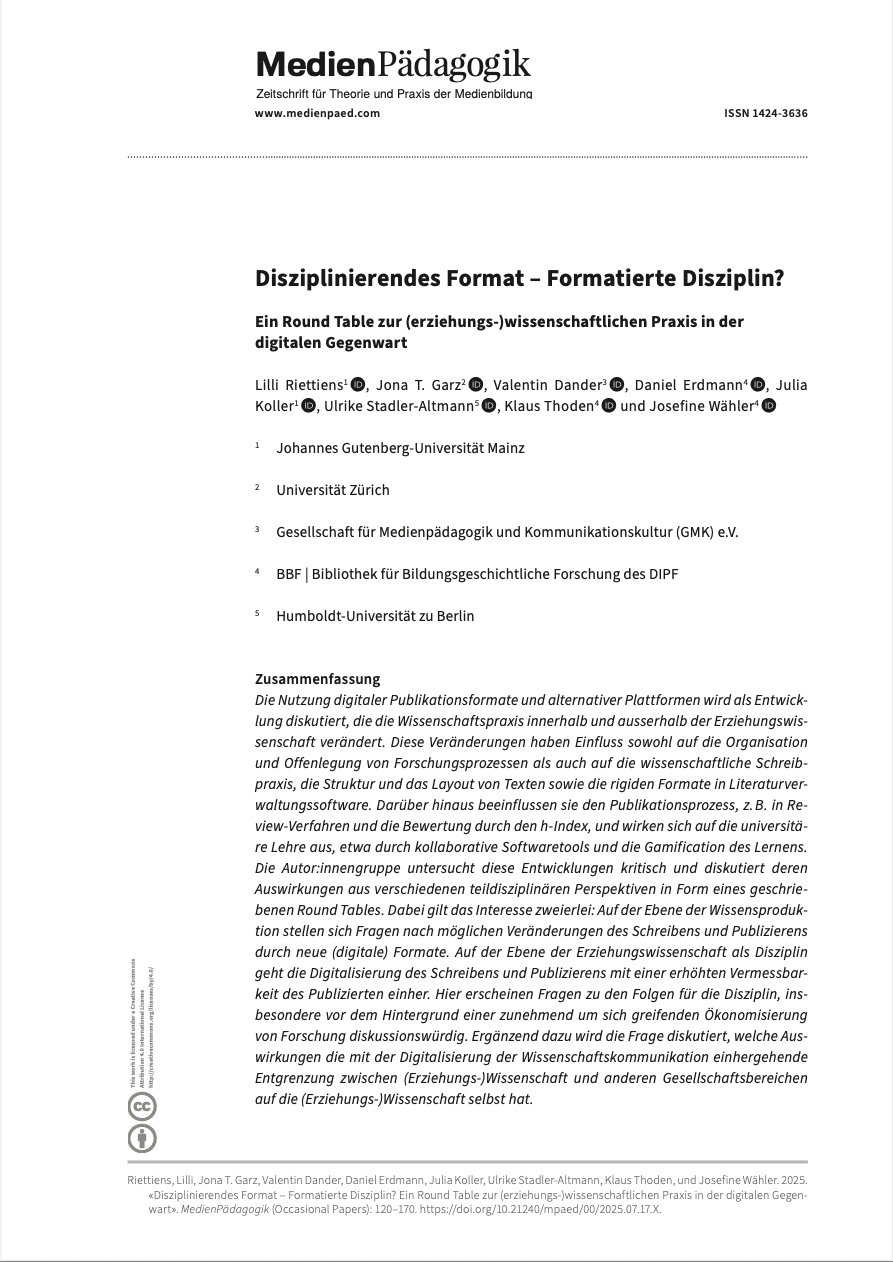
Im Juli 2025 ist unser schriftlicher Round Table in der Zeitschrift für Medienpädagogik erschienen. ›Unser‹ – das sind Jona T. Garz, Valentin Dander, Daniel Erdmann, Julia Koller, Ulrike Stadler-Altmann, Klaus Thoden, Josefine Wähler und ich.
Als AdHoc-Gruppe beim DGfE-Kongress 2024 an der MLU Halle-Wittenberg stellten wir acht uns der Frage, ob und inwiefern es sich bei der Nutzung digitaler Publikationsformate und alternativer Plattformen um eine Entwicklung handelt, die die Wissenschaftspraxis innerhalb und ausserhalb der Erziehungswissenschaft verändert. Denn womöglich haben diese Veränderungen sowohl Einfluss auf die Organisation und Offenlegung von Forschungsprozessen als auch auf die wissenschaftliche Schreibpraxis, die Struktur und das Layout von Texten sowie die rigiden Formate in Literaturverwaltungssoftware. Darüber hinaus beeinflussen sie den Publikationsprozess, z. B. in Review-Verfahren und die Bewertung durch den h-Index, und wirken sich auf die Hochschullehre aus, etwa durch kollaborative Softwaretools und die Gamification des Lernens.
Also: Disziplinierendes Format oder formatierte Disziplin?
Zum Format Round Table
In Form eines geschriebenen Round Tables im Vorfeld zum Kongress tauschten wir uns also zu drei zentralen Fragen aus:
- (Inwiefern) Verändern Software, digitale Formate und technische Nicht/Machbarkeit die Art und Weise unserer Wissensproduktion (bspw. mit Blick auf das Schreiben und Publizieren)?
- (Inwiefern) Machen Sie eine Wechselwirkung von Digitalisierung Wissenschaft(spraxis) und Ökonomisierung aus?
- Welche Auswirkungen haben diese Entwicklungen (möglicherweise) auf die Erziehungswissenschaft als Disziplin (in Forschung und Lehre)?
In Runde I beantworteten alle Beteiligten die Fragen aus ihrer (teil)disziplinären Verortung heraus. Darauf folgte Runde II, in der die Antworten der jeweils Anderen kommentiert, Rückfragen gestellt und weiterführende Ideen entwickelt wurden.
Wir danken Klaus Rummler und der Zeitschrift für Medienpädagogik für ihre Bereitschaft, einen solch Format-sprengenden Text zu drucken (#Zeichenzahl). Unser Dank gilt außerdem den Gutachtenden im double blind-Verfahren sowie dem Lektor der Zeitschrift für ihre wertvollen Kommentare.
In July 2025, our written round table was published in the Zeitschrift für Medienpädagogik. By ›our,‹ we mean Jona T. Garz, Valentin Dander, Daniel Erdmann, Julia Koller, Ulrike Stadler-Altmann, Klaus Thoden, Josefine Wähler and myself.
As an ad-hoc group at the DGfE-Congress 2024 at Martin Luther University Halle-Wittenberg, the eight of us explored the question of whether — and to what extent — the use of digital publication formats and alternative platforms represents a development that is transforming scientific practice, both within and beyond the field of education research. These shifts may affect how research processes are organized and made transparent, influence academic writing practices, impact the structure and layout of scholarly texts, and challenge the rigid formatting rules of reference management software. Furthermore, such developments shape the publication process itself — for example, peer review procedures and evaluation metrics like the h-index — and also influence vocational training, through collaborative software tools and the gamification of learning.
So: Disciplining format or formatted discipline?
About the Round Table Format
In the form of a written round table in the lead-up to the congress, we exchanged ideas on three central questions:
- (How) Do software, digital formats, and technical (im)possibilities change the way we produce knowledge (e.g., in terms of writing and publishing)?
- (How) Do you perceive a mutual influence between digitization, scientific practice, and the economization of academia?
- What effects might these developments have on education research as a discipline — in both research and teaching?
In Round I, all contributors answered these questions from their own (sub)disciplinary perspectives. In Round II, we responded to each other’s answers, posed follow-up questions, and developed further ideas. The text that follows is the result of this exchange.
We thank Klaus Rummler and the Zeitschrift für Medienpädagogik for their willingness to publish a text that defies conventional formats (#characterlimit). Our gratitude also goes to the anonymous reviewers in the double-blind review process, and to the journal’s proof reader for their valuable comments.

 Lilli Riettiens