Sektionstagung Historische Bildungsforschung | HU Berlin 2023

Humboldt-Universität zu Berlin | 11. bis 13. September 2023

English version below

Vom 11. bis 13. September fand an der Humboldt Universität Berlin die Jahrestagung der Sektion Historische Bildungsforschung der Deutschen Gesellschaft für Erziehungswissenschaft statt. Organisiert von Marcelo Caruso, Till Kössler und Sabine Reh diskutierten wir Fragen von Freiheit und Gleichheit in der Bildungsgeschichte, wobei neben gegenstandsbezogenen und method(olog)ischen insbesondere auch wissensgeschichtliche und (standpunkt)epistemologische Fragen in den Fokus rückten.

Wie können wir Un/Gleichheit (historisch) beforschen? Und welche Rolle spielt Bildung darin, wenn wir davon ausgehen, dass es sich bei ihr um ein »Scharnier [handelt], das in beide Richtungen funktioniert« (Thomas Mergel | Podiumsdiskussion)?

Epistemologische Fragen wurden ebenfalls im Zuge der Eröffnung des Digital History of Education Lab der Bibliothek für bildungsgeschichtliche Forschung adressiert, die vor allem im Anschluss an die Keynote von Torsten Hiltmann kritisch diskutiert wurden. Denn: (In)Wie(fern) verändert sich (bildungs)historisches Forschen angesichts von Digitalisierung und unter Bedingungen von Digitalität? Transformieren sich tatsächlich die grundlegenden Logiken?

Im Rahmen der Mitgliederversammlung wurde zudem ein neuer Vorstand gewählt: Esther Berner, Michèle Hofmann und Michaela Vogt. Und ein großer Dank wurde und wird Marcelo Caruso für seine Arbeit als bisheriger Vorstandsvorsitzender zuteil.

Im Vorfeld der Sektionstagung fand zudem das 15. Forum junger Bildungshistoriker_innen statt, bei dem 15 Promovierende die Gelegenheit hatten, ihre Projekte – unabhängig des Tagungsthemas – vorzustellen und zu diskutieren. Organisiert wurde das Forum von Andreas Oberdorf und Stefanie Vochatzer und ich selbst hatte das Vergnügen, als Chair des Panels zu Erziehungs- und Bildungsmedien zu fungieren.

Auch die Sprecher_innen der Emerging Researcher wurden neu gewählt, da die Amtsperiode(n) von Andreas Oberdorf endete. Die Wahl fiel auf Anna Strunk und Stefanie Vochatzer, die unmittelbar mit Überlegungen zur Ausgestaltung des 16. Forums junger Bildungshistoriker_innen begannen.


[English Version] From 11 to 13 September the Conference for the History of Education of the German Society for Educational Research was held at the Humboldt University Berlin. Organised by Marcelo Caruso, Till Kössler and Sabine Reh, we discussed questions of Freedom and Equality in the History of Education, focusing not only on method(olog)ical aspects but also on the history of knowledge and epistemologies.

How can we investigate in/equality (historically)? And what role do education and Bildung play in this, if we assume that they are a »hinge that works in both directions« (Thomas Mergel | panel discussion)?

Epistemological questions were also addressed in the course of the opening of the Digital History of Education Lab of the Research Library for the History of Education, which were critically discussed after Torsten Hiltmann’s keynote: (How) Does (educational) historical research change in the face of digitalisation and under the digital condition? Are the underlying logics really being transformed?

A new Executive Commitee was also elected at the general assembly: Esther Berner, Michèle Hofmann and Michaela Vogt. And a big thank you went and will go to Marcelo Caruso for his work as the speaker of the EC in the past years.

In the run-up to the conference, the 15th Forum of the Emerging Researchers in the History of Education took place, where 15 doctoral students had the opportunity to present and discuss their projects. The forum was organised by Andreas Oberdorf and Stefanie Vochatzer and I myself had the pleasure of chairing the panel on educational media.

The speakers of the Emerging Researchers were also (re-)elected as Andreas Oberdorf’s term(s) ended. The choice fell on Anna Strunk and Stefanie Vochatzer, who immediately began to reflect on the design of the 16th Forum of Emerging Researchers in the History of Education.

[discussant] Customized Diversity? | ECER2023

University of Glasgow | 22-25 August 2023

At the end of August, the University of Glasgow hosted this year’s ECER (European Conference on Educational Research) on the theme The Value of Diversity in Education and Educational Research, at which I was able to give a talk (see previous post) as well as act as a discussant. My stay there was financially supported by the internal research funding of Johannes Gutenberg University Mainz.

Valentin Dander (HCH Potsdam), Theo Hug (University of Innsbruck) and Rachel Shanks (University of Aberdeen) had organised the Symposium with the titel Customized Diversity? Critical Explorations of Educational Capitalism to address the following questions:

  • How are today’s globalized assemblages of educational capitalism relevant to issues of diversity?
  • What kind of ideas and values are underpinning the concept and where do they come from?
  • Which goals, methods and forms of critical media education are important to strengthen democratic and sustainable development paths in media development, in the use and design of digital media?
  • What is the role of media educational research for designing for knowledge diversity and viable futures of education?

The symposium consisted of Four Talks, which I then had the opportunity to comment on and discuss:

  1. Adaptive Learning – the New Mantra? Ideas About the Use of New Technology in Tomorrow’s School (Geir Haugsbakk & Siri Wieberg Klausen | Norway University of Applied Sciences (INN University))
  2. Changing Knowledge Ecologies in Educational Research Production in Austria, Germany, and Italy: Towards Customized Knowledge Diversity? (Ulrike Stadler-Altmann | Humboldt University of Berlin, Barbara Gross | University of Technology Chemnitz & Theo Hug | Universität Innsbruck)
  3. The Future of Our Children in the Hands of Three Giants Called McGoogle, MacMicrosoft and Fitzapple (Andrew McLaughlin & Rachel Shanks | University of Aberdeen)
  4. Teaching for Digital Citizenship: Affective Polarization in Scottish Schools (David Lundie | University of Glasgow)

In my Commentary, I was particularly concerned with highlighting what I saw as the connecting lines to then open up two perspectives to stimulate further discussions: firstly, a somewhat historically-informed perspective on the re-appearance of the reduction of Bildung and education; secondly, reflections on the objectification of knowledge that ›plays beautifully into capitalism’s cards‹.

Connecting Lines: The Involvement of Tech Companies in the Context of Education and The Question of Knowledge and it’s Re-Production

Line I: On a level that may seem superficial at first, appears the ›Provision‹ of Learning Tools by Tech Companies. The talks addressed an important point that also Shoshana Zuboff emphasises: The accumulation of ›knowledge and knowers‹. Zuboff writes that »intellect and expertise […] [are] being concentrated in a handful of companies« (Zuboff 2018: 222) – which weighs heavily in the educational context in that »schools and teachers, rather than having a feast at a digital banquet, find their menus reduced. Their ability to choose the best tools replaced by resourcefulness, the most competent making the best of what is available.« (McLaughlin/Shanks). Timewise the education sector is lagging behind. Where capital, technical know-how, marketing know-how and data are accumulated, however, things move quickly.
Line II: The papers addressed that in the face of frequent Technological Optimism all too often there are positivist accounts of supposed customisation due to increasing ›knowledge‹ about – in this case – learners.

To be continued. Perspective I

What becomes apparent, in my view, is firstly the historically recurring emergence of a Reduction of Bildung and Education. This reduction is based on ideas of measurability and evidence (among others Aronova et al. 2017; Hofhues/Riettiens 2023/in press; Selwyn et al. 2023). Here, an orientation towards optimisation logics becomes apparent, because: Particularly in the context of learning tools and learning analytics it is suggested that, for example, learning processes can be made more ›effective‹ through digital data and can thus be optimised. (Digital) Data appear here both as an ›objective‹ means of description and as a kind of ›universal remedy‹ with which processes can be better analysed and optimised. Those developments around the collection, evaluation, and use of data in contexts of formal education thus become readable as an understanding of learning characterised by optimisation. This is interested in evidence, follows the desire for controllability of Bildung and education, and materialises in socio-technical systems. At the same time, it perpetuates the data-based attempt at precise predictions and determinability with regard to human beings as deficient beings that need to be further developed (among others Dederich/Zirfas 2021). However, human beings – according to my critique – do not fully merge into this (see previous post).

To be continued. Perspective II

With regard to the production of knowledge my second perspective moves in the interplay of education, Bildung and capitalism: learning tools and the like are based on path logics that limit the »space of possibilities«, because »in a sense [they] put the learners on rails« (Seemann et al. 2022: 52). These rails take a discursively negotiated and narrowed path that leads the learners to the next path decision and so on. With Peter Becker and William Clark, for example Adaptive Learning Tools can be read as Little Tools of Knowledge – a concept that originally stems from the research context around bureaucracies and helps analysing »the relations between authority and objectivity« (Becker/Clark 2001: 1; Garz/Riettiens 2023). The focus here is thus on the epistemic effects of those tools, which arise in particular from the fact that the knowledge reduced in them is given a kind of objective coating.
Peter Becker and William Clark refer to the concept of dehumanisation, which they trace back to Weber’s reflections on capitalism: capitalism would function all the better, »the more [bureaucracy; L. R.] ›dehumanizes [entmenschlicht],‹ […]. Instead of the personal interest, favor, grace, gratitude, which motivated the master of older orders, modern culture, the more complex and specialized it becomes, demands, for the external apparatus underpinning it« (Weber 1976: 563 in Becker/Clark 2001: 4). Little tools of knowledge thus become a central component of this dehumanised apparatus and appear like disembodied »self-evident facts and truths« (Becker/Clark 2001: 5; see also Haraway 1988; Preciado 2021).
My discussant point was and is therefore the following: Dehumanisation and Disembodiment seem to be increased by Technification and Digitisation, which is especially problematic regarding the tech companies behind them and their capitalist interests. For when we talk about former top managers of Google (Haugsbakk/Wieberg Klausen) or giant tech companies founding, financing, and providing concepts, platforms as well as learning and analytic tools in the field of education (McLaughlin/Shanks), then the dehumanisation that Weber already described as particularly ›helpful‹ for capitalism is especially problematic. Thus, digitisation can be read as an optimising force in an already highly developed capitalism (Pfeiffer 2021), as: On the one hand, the underlying market-shaped interests are disguised and even given a sometimes positive veneer #charityWashing. On the other hand, the underlying ideas of human beings as deficient beings, who appear to be optimisable if only enough data and consequently ›knowledge‹ about them are available, are also concealed. Contrary to a diversity-sensitive or even diversity-promoting customisation standardisations, normalisations and disciplinarisations are emerging in the disembodied learning tools and platforms, which further nourish ›dehumanised‹ capitalism. [short version]

Bibliography

Aronova, Elena/Oertzen, Christine von/Sepkoski, David (eds.) (2017): Data Histories, in: Osiris. A Research Journal Devoted to the History of  Science and Its Cultural Influences 32.

Becker, Peter/Clark, William (2001): Introduction, in: Little Tools of Knowledge. Historical Essays on Academic and Bureaucratic Practices. Michigan, pp. 1-34.

Dederich, Markus/Zirfas, Jörg (2021): Idealtypen einer pädagogischen Anthropologie der Optimierung, in Henrike Terhart/Sandra Hofhues/Elke Kleinau (eds.): Optimierung. Anschlüsse an den 27. Kongress der Deutschen Gesellschaft für Erziehungswissenschaft, pp. 63–81. Opladen.

Garz, Jona T./Riettiens, Lilli (2023): Small Forms and Formats and their Epistemic Effects on [History of Education] Publishing. [Talk]

Haraway, Donna (1988): Situated Knowledges. The Science Question in Feminism and the Privilege of Partial Perspective, in: Feminist Studies, Vol. 14, No. 3, pp. 575-599.

Hofhues, Sandra/Riettiens, Lilli (2023/in press): Digitalität, in: Markus Dederich/Jörg Zirfas (eds.): Optimierung. Ein interdisziplinäres Handbuch. Stuttgart.

Pfeiffer, Sabine (2021): Digitalisierung als Distributivkraft: über das Neue am digitalen Kapitalismus. Bielefeld.

Preciado, Paul (2021): Can the monster speak? Report to an Academy of Psychoanalysts. London.

Seemann, Michael/Macgilchrist, Felicitas/Richter, Christoph/Allert, Heidrun/Geuter, Jürgen (2022): Konzeptstudie. Werte und Strukturen der Nationalen Bildungsplattform. Wikimedia Deutschland. Online [29.08.2023].

Selwyn, Neil/Hillman, Thomas/Bergviken Rensfeldt, Annika/Perrotta, Carlo (2023): Digital Technologies and the Automation of Education — Key Questions and Concerns, in: Postdigital Science and Education 5, pp. 15–24.

Zuboff, Shoshana (2018): Das Zeitalter des Überwachungskapitalismus. Frankfurt a. M.

[talk] Normalizing the Menstruating Body | ECER2023

University of Glasgow | 22-25 August 2023

At the end of August, the University of Glasgow hosted this year’s ECER (European Conference on Educational Research) on the theme The Value of Diversity in Education and Educational Research, at which I was able to give a talk as well as act as a discussant (see next post). My stay there was financially supported by the internal research funding of Johannes Gutenberg University Mainz.

Together with Juliane Ahlborn and Dan Verständig (both Bielefeld University) I organized the Symposium Normalizing the Body. Addressing the Lack of Diversity in Digital Technologies and What It Means for Educational Science. It consisted of three talks and a commentary by Aline Nardo (University of Edinburgh) and was chaired by Klaus Rummler (PH Zurich):

  1. Normalizing the Menstruating Body. Self-Measurement, Algorithmic Recommendation and Little Tools of Knowledge (Lilli Riettiens | University of Mainz)
  2. Damn Data! On the Explorative Role of AI in Artistic Processes (Juliane Ahlborn | Bielefeld University)
  3. Beauty and the Biased: How Content Regulation on TikTok Diminishes Diversity and What Media Education Can Do About It (Dan Verständig | Bielefeld University)

The Starting Point of our Idea for this symposium was the critical questioning of the initially widespread promise that digitization and, specifically, the internet and social media platforms, will make participation and representation more diverse. Our thesis was that the interference of algorithmic systems does not lead to a diversification of body images and representations, but rather to normalization and standardization.

Normalizing the Menstruating Body

In my talk, I theorized menstrual cycle apps as Little Tools of Knowledge (Becker/Clark 2001) insofar as the entry options presented to the users contain and re-produce miniaturised ›knowledge‹ about menstruating bodies that is discursively pre-negotiated. When choosing the analytical perspective of the small forms, formats and the little tools of knowledge a paradoxical field of tension between supposed universality and objectivity on the one hand and supposed individuality on the other opens up. Here I was referring to Donna Haraway’s idea of situated knowledges and the God trick (Haraway 1988) and Paul Preciado’s speech to his »beloved binary friends« (Preciado 2021: 18): Against the backdrop of those Queer Feminist Considerations objectivity and universalism appear as the result of that process within which the respective signifiers seem to be free from a particular and situated position – as if they had no body, as if they were free from »an inevitably disqualifying and polluting bias«, according to Haraway (Haraway 1988: 575) – and their »great little tool« (Becker/Clark 2001: 5) are forms, protocols, lists, graphs and tables … and apps?

By reconstructing (historically) the ›knowledge‹ about menstruation at the intersection of medical-psychiatric, gender-theoretical and educational discourses, I was able to point out continuities in the negotiation of menstruating bodies, which can be read as a/normalizations and standardizations, and which become even more potent when technical systems interfere.

Thinking further

My talk ended with ideas on the relationship between Body, Leib and Bildung, because: if we assume with Robert Gugutzer that »the knowledge I have of the body« dictates »[w]hat I sense« (Gugutzer 2015: 22), then »one’s own Leib experience […] [also] proves to be socioculturally shaped« (Götte 2017: 91) and dependent on »the respective historical knowledge about the body« (Kalthoff/Rieger-Ladich/Alkemeyer 2015: 19; Riettiens 2022). I think of this further in (at least) two directions:
(1) In view of the little tools of knowledge and their ›ability‹ to re-produce, objectify and universalise knowledge, their significance becomes particularly clear when we ask ourselves questions about the effects of these processes on the ›knowledge‹ of one’s own body and thus on one’s own body image and the Leib.
(2) With regard to Bildungstheory, we must assume that people are never completely subsumed in these miniaturisations and reductions. Accordingly, a paradox opens up, on one side of which there is an almost affirmative socio-technical action that is driven by the fear of illness or of being marked as ›abnormal‹. On the other side, there is a possibly productive irritation, since it is not only the bodily sensing that is »sometimes stubborn and resistant« (Gugutzer 2015: 102), but also the human being in its confrontation with the small forms and formats in which it does not fit.


Bibliography

Becker, Peter/Clark, William (2001): Introduction, in: Little Tools of Knowledge. Historical Essays on Academic and Bureaucratic Practices. Michigan, pp. 1-34.

Götte, Petra (2017): Inszenierung von Familie im Medium privater Fotografie. Deutsche Auswanderinnen und Auswanderer in den USA in der ersten Hälfte des 20. Jahrhunderts. Unveröffentlichte Habilitationsschrift (Monografie) zur Erlangung der Lehrbefähigung und der Lehrbefugnis im Fach Erziehungswissenschaft, Köln.

Gugutzer, Robert (2015): Soziologie des Körpers, 5th edition. Bielefeld.

Haraway, Donna (1988): Situated Knowledges. The Science Question in Feminism and the Privilege of Partial Perspective, in: Feminist Studies, Vol. 14, No. 3, pp. 575-599.

Kalthoff, Herbert/Rieger-Ladich, Markus/Alkemeyer, Thomas (2015): »Bil- dungspraxis – eine Einleitung«, in: Thomas Alkemeyer/Herbert Kalthoff/Markus Rieger-Ladich (eds.): Bildungspraxis – Körper. Räume. Objekte. Weilerswist, pp. 9-33.

Preciado, Paul (2021): Can the monster speak? Report to an Academy of Psychoanalysts. London.

Riettiens, Lilli (2022): Doing Journeys. Transatlantische Reisen von Lateinamerika nach Europa schreiben (1839-1910). Bielefeld.


HEDSS2023 | University of Zurich

8-10 June 2023

The 13th History of Education Summer School, originally launched as a pilot project of the EERA (European Educational Research Association), took place at the University of Zurich and Schloss Au from 8-10 June. The local organising committee consisted of Anne Bosche (Zurich University of Teacher Education and Pestalozzianum Foundation), Lukas Boser (University of Basel), Patrick Bühler (FHNW University of Teacher Education), Frederik Herman (Schwyz University of Teacher Education) and Michèle Hofmann (University of Zurich).

After having been a participant myself in 2018, I was now invited to act as a tutor and to give a workshop for the participating PhD students. It was an honour to be part of the summer school together with my esteemed colleagues Lisa Rosén Rasmussen (Aarhus University, Denmark), Björn Norlin (Umeå University, Sweden), Ian Grosvenor and Siân Roberts (University of Birmingham, UK), Angelo Van Gorp (University of Koblenz-Landau, Germany) and Tom Woodin (IOE, UCL’s Faculty of Education and Society, UK and History of Education Society, UK).

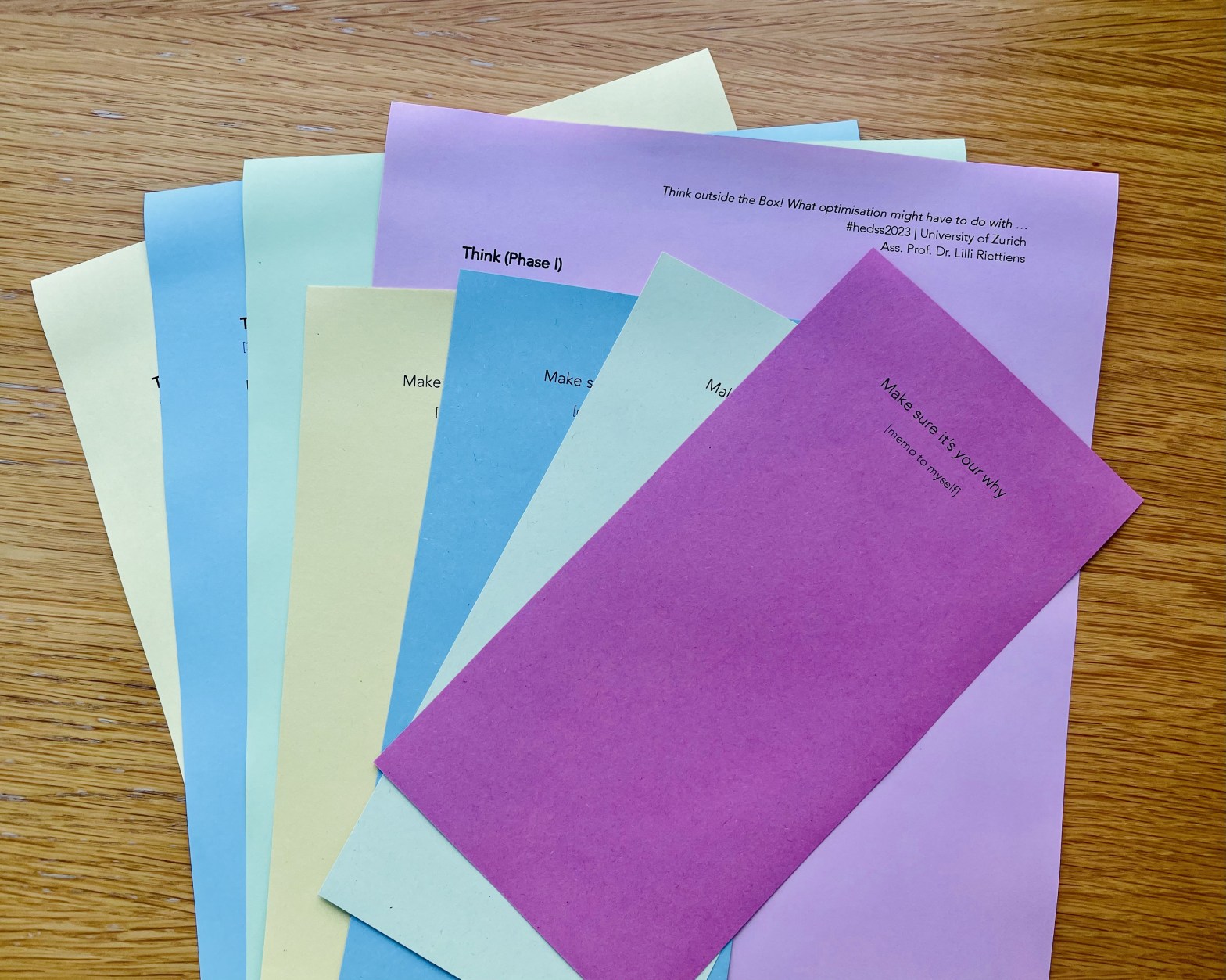
The aim of my one-hour workshop named ›Think outside the Box!‹ was to encourage the participants to develop ideas on how their PhD topic can be read in the context of the given theme of ›optimisation‹. The background to this was, on the one hand, that the current academic world repeatedly demands researchers to position themselves on certain current topics and readings, for example for conferences or articles in scientific journals, but also for job applications. On the other hand, such considerations – which may initially be associative – often lead to looking at one’s own research topic from a different perspective. Thinking outside the box can bring new insights, changed approaches and, in any case, a stepping outside of one’s own boundaries.

[talk] Small Forms and Formats in [History of Education] Publishing | ISCHE44

July 17 2023 | Eötvös Loránd University | Ungarn

German [short] version below

The pre-conference workshop Changing Forms and Formats | Digital Writing and Digital Publishing in the History of Education was held at the start of this year’s 44th International Standing Conference for the History of Education in Budapest. It was organised by Josefine Wähler, Lars Müller, Klaus Thoden and Sabine Reh (BBF | DIPF Berlin). Jona T. Garz (University of Zurich) and I were present with a theoretical talk on Small Forms and Formats and Epistemic Effects on [History of Education] Publishing.

We focused on the Epistemic Relevance of Small Forms and Formats using two threads of thought and outlined them as an analytical approach to take into account changing research and publication conditions in (historical) educational research. We followed the premise that a specific worldview as well as specific possibilities of articulation are inscribed into these small forms and formats, what challenges researchers to relate to them. This makes it clear that the underlying logics of the digital variants of small forms and formats can by no means be understood as new, especially with regard to their epistemic effects on (historical) educational research. Instead, we propose to understand Small Forms and Formats as Material Preconditions for Knowledge Production and Circulation, the epistemic effects of which need to be investigated over time.

We thus suggest(ed) that the supposed ›digital media revolution‹ has hardly found expression in the underlying logics of historical (educational) research – neither regarding epistemic practices nor power or powerlessness in publishing. Instead of epistemic and disciplinary effects of (post-)digitality, we should maybe Focus on the Conditions of Production and their Ecological Effects of changing Publishing Practices:

  • Who rules the small forms and formats in the digital present?
  • Who benefits from the provision of small formats as an infrastructure that dictates who can and ultimately may publish what, where and in what form?

In our view, the search for, or rather the work on, digital small forms and formats would mean Taking Responsibility for one’s own Ideas and thus for the world they enact. [short version]


[German Version] Als Auftakt der diesjährigen 44. International Standing Conference for the History of Education in Budapest fand der Pre-Conference Workshop Changing Forms and Formats | Digital Writing and Digital Publishing in the History of Education statt. Organisiert wurde er von Josefine Wähler, Lars Müller, Klaus Thoden und Sabine Reh (BBF | DIPF Berlin). Mit dabei waren Jona T. Garz (Universität Zürich) und ich mit einem grundlagentheoretischen Vortrag zu Small Forms and Formats and Epistemic Effects on [History of Education] Publishing.

Darin widmeten wir uns anhand zweier Gedankenstränke der epistemischen Relevanz kleiner Formen und Formate und skizzierten diese als analytischen Ansatz, um sich verändernde Forschungs- und Publikationsbedingungen in der (historischen) Bildungsforschung in den Blick zu nehmen. Wir folgten der Prämisse, dass kleinen Formen und Formaten ein spezifisches Weltbild ebenso eingeschrieben ist wie spezifische Möglichkeiten der Artikulation, was Forschende gleichsam herausfordert, sich dazu ins Verhältnis zu setzen und eine orientierende Haltung aufzubauen. Damit wird deutlich, dass die grundlegenden Logiken der digitalen Varianten kleiner Formen und Formate vor allem im Hinblick auf ihre epistemischen Effekte auf (historische) Bildungsforschung keineswegs als neu verstanden werden können. Stattdessen schlagen wir vor, kleine Formen und Formate als materiale Voraussetzungen von  Wissensproduktion und -zirkulation zu verstehen, deren epistemische Effekte es über die Zeit hinweg zu untersuchen gilt.

Anhand exemplarisch ausgewählter Beispiele illustrierten wir, dass eine solche Auseinandersetzung, ertragreich ist, um nicht dem im Kontext der Digitalisierung oft bemühten Narrativ des ›radikal Neuen‹ zu verfallen und stattdessen historische Kontinuitäten in den Blick zu rücken. [Kurzfassung]


Internationaler PostDoc-Workshop | Universität Zürich

05./06. Mai 2023

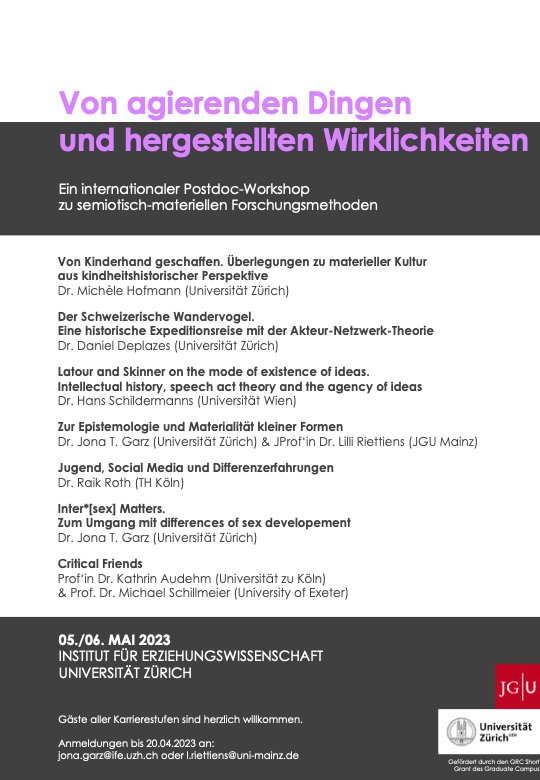
Gemeinsam organisieren Jona T. Garz und ich Anfang Mai 2023 einen internationalen Workshop für PostDocs zu semiotisch-materiellen Forschungsmethoden an der Universität Zürich.

Während sich für PhDs zahlreiche Summer Schools, Methoden-Workshops und Vernetzungsangebote finden, bilden solche Formate für PostDocs häufig ein Desiderat. Gleichzeitig erfordert die auf die Promotion folgende Phase auf mehreren Ebenen eine Neu-Orientierung auf Seiten der PostDocs: Einerseits wird erwartet, dass eine weitere Spezialisierung stattfindet, die sich in Teilen ambivalent zu der Forderung verhält, sich inhaltlich, theoretisch und methodisch breiter aufzustellen. Andererseits soll die PostDoc-Phase zudem dem Aufbau (inter-)nationaler Netzwerke dienen.

Unser Workshop zielt daher auf die Erweiterung des method(olog)ischen Repertoires und auf internationale Vernetzung ab. Entsprechend bringen wir PostDocs aus der Schweiz, aus Deutschland und Österreich in der frühen Phase ihres zweiten Buchprojektes – im wahrsten Sinne – an einen Tisch. An der Schnittstelle von Erziehungs-, Medien- und Sozialwissenschaften soll gemeinsam auf Grundlage konkreter Projekte bzw. Projektideen der Teilnehmenden über method(olog)ische Herangehensweisen diskutiert werden.

Ringvorlesung Medien & Bildung

Winter 2022|2023

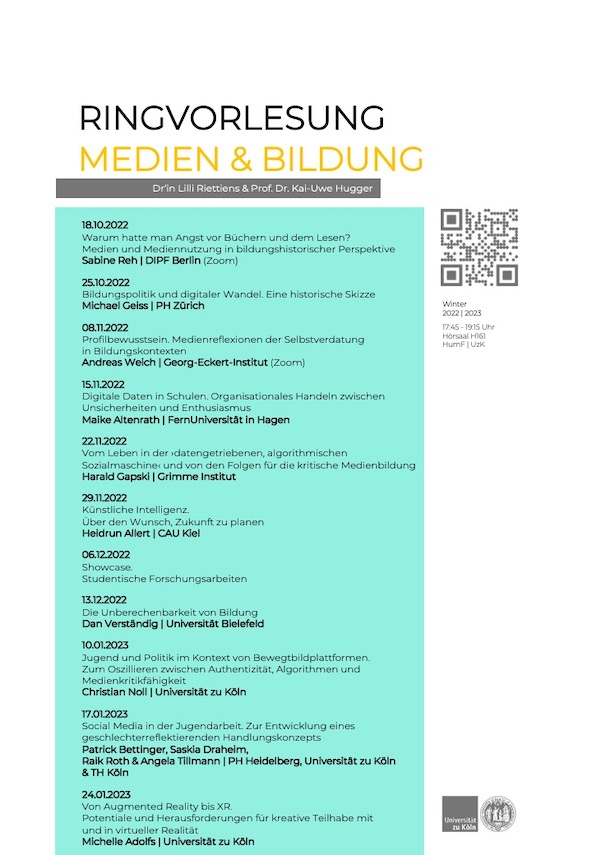
Gemeinsam haben Kai-Uwe Hugger und ich in diesem Winter eine Ringvorlesung zum Konnex von Medien und Bildung organisiert.

Dabei setzten wir vier thematische Schwerpunkte:

  1. Historische Zugänge zu Medien und Bildung
  2. Datafizierung | Big Data | Data Literacy
  3. Code | Algorithmen | ›Künstliche Intelligenz‹
  4. MedienVielfalt: (Bewegt-)Bilder | Social Media | Augmented Reality

Ziel der Ringvorlesung war, die Bedeutung von (digitalen) Medien und deren möglichen Wandel in (informellen, formalen und non-formalen) Lern- und Bildungskontexten darzustellen und vor dem Hintergrund von aktuellen Diskursen der Erziehungswissenschaft und erziehungswissenschaftlichen Medienforschung zu reflektieren und zu diskutieren.

[text] »Kritische Perspektiven auf (Subjekt-)Bildung in einer datafizierten Gegenwart« in der merz Wissenschaft

Dezember 2022

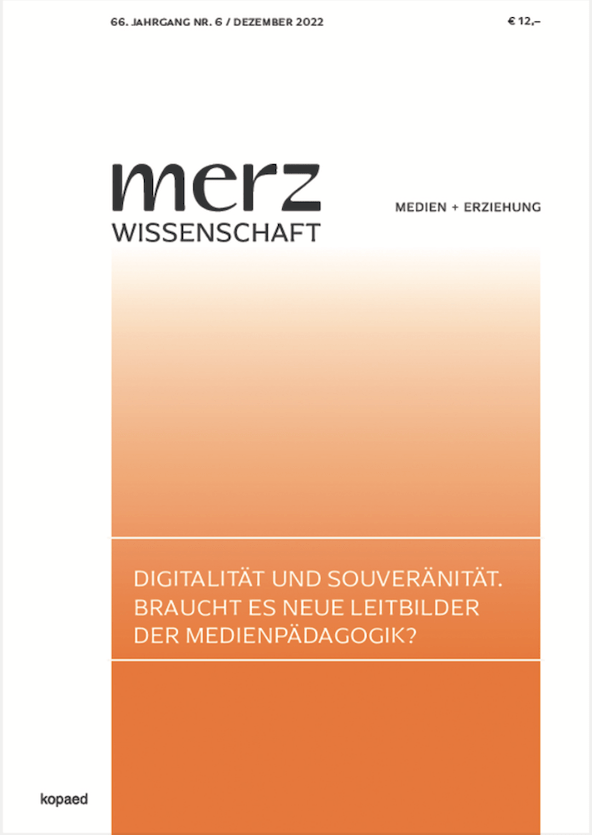
Im Dezember ist das Themenheft Digitalität und Souveränität. Braucht es neue Leitbilder der Medienpädagogik? der merz Wissenschaft erschienen.

Ich freue mich, dass sich darin mein Beitrag zu Fragen von Nicht-Souveränität und subjektiver Relationalität findet. Darin lege ich Optimierungslogiken und eine Diskrepanz zwischen einem Selbstbestimmungspostulat bei gleichzeitiger Orientierung an präskriptiv-normativen Kompetenzen offen.

Angesichts algorithmischer Präfigurationen in einer Kultur der Digitalität gilt es meines Erachtens stärker die hervorbringenden Bedingungen der Subjekt-, aber auch der Menschwerdung in den Fokus zu rücken. Denn indem wir forscherisch die »strukturellen Agenten von Subjektiva- tionsprozessen« (Engel/Karpowitz 2022: 203) in einer Kultur der Digitalität ausmachen, scheint kritische Handlungsfähigkeit möglicherweise dort auf, wo das Subjekt seine Souveränität riskiert und sich in seiner Nicht-Souveränität befragt.

[text] »Der _ als paradoxe kleine Form« im Band ›Doing Research‹

November 2022

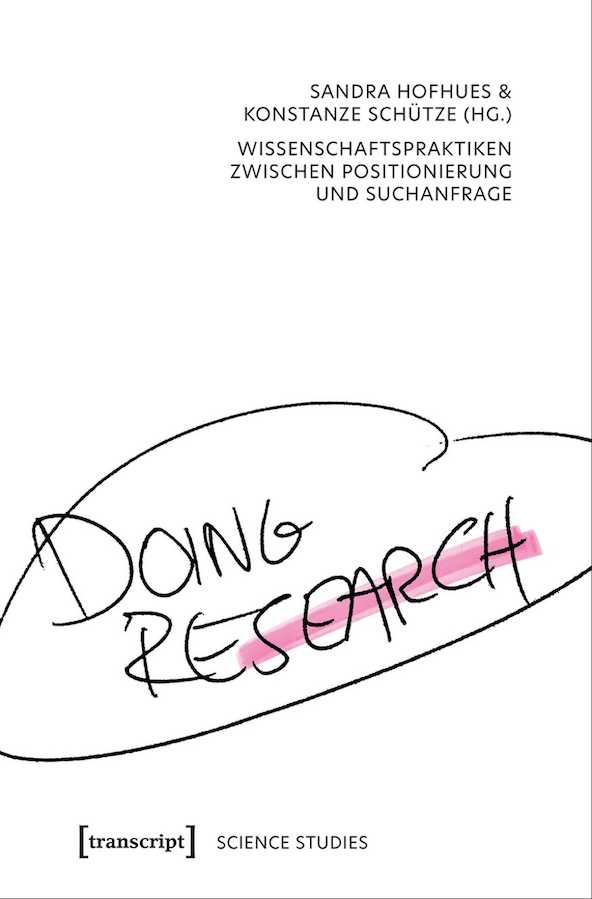
Im November ist der Band Doing Research open access erschienen, mit dem die beiden Herausgeberinnen Sandra Hofhues und Konstanze Schütze neue Maßstäbe setzen. Mehr als 50 wissenschaftliche und künstlerische Beiträge widmen sich anhand der »vermeintlich kleinsten Einheiten wissenschaftlicher Verständigung« – der Abkürzung – dem Prozess des Forschens.

Gemeinsam haben Jona T. Garz und ich uns im Rahmen unseres Beitrages dem _ gewidmet, den wir als paradoxe kleine Form begreifen: Zwar ermöglicht er einerseits die Komprimierung eines Diskurses auf engem Raum, in der gleichen Bewegung vergrößert er jedoch den Raum im Nachdenken über vergeschlechtlichte Subjekte. Als typografische Intervention wird der _ damit zu einer Raumaneignung, die gleichsam von Verweilen und Bewegung geprägt ist. Denn während es gilt, »diesen Raum dauerhaft zu besetzen« (S_HE 2003: o.S.), markiert der _ doch ebenso einen fluiden Prozess absichtsvoll unabschließbarer De- und Rekonfigurationen von Geschlechtsmöglichkeiten jenseits binärer Substantive.

[text] »Formatierte (A)Normalität« im Band ›Das (A)Normale in der Pädagogik‹

Oktober 2022

Im Oktober ist der Band Das (A)Normale in der Pädagogik open access bei Klinkhardt erschienen, der in differenz- und bildungstheoretischer Perspektive verschiedenen Diskursen zur Hervorbringung des pädagogischen (A)normalen zwischen 1900 und 1970 nachgeht.

Darin enthalten ist mein Beitrag zur ›Formatierten (A)Normalität‹, in dem ich machtvolle Konstellationen, historische Gewordenheiten und die Erzeugung von ›Wissen‹ im Kontext des deutschen Kolonialismus nicht nur auf inhaltlicher Ebene zu fassen suche, sondern sie ebenso in einen größeren mediengeschichtlichen Kontext einordne.

Am Beispiel des historischen Kolonialromans für Kinder und Jugendliche geht es also um Formate, Formatierungen und damit einhergehende (A)Normalisierungen jenseits formaler Bildungskontexte.